What Is the Rotator Cuff?
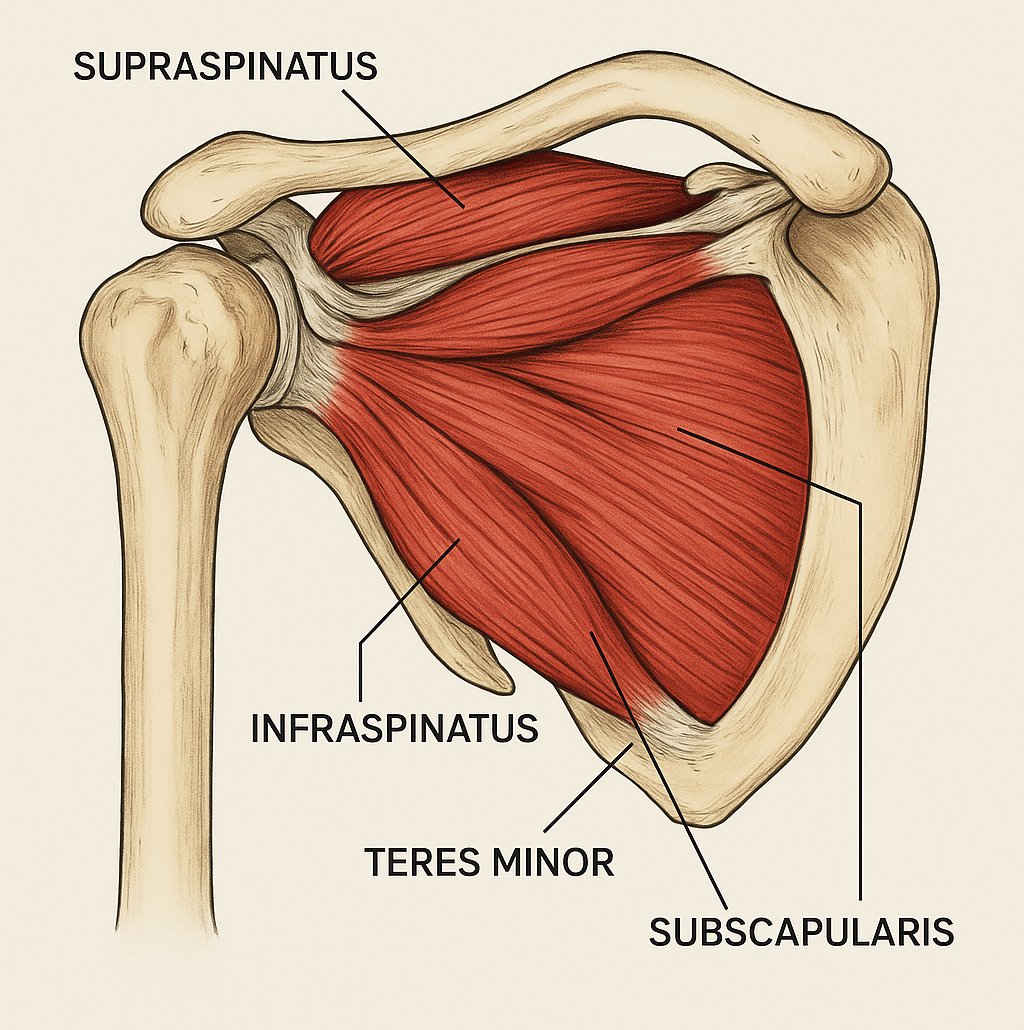
The rotator cuff is a group of four small but powerful muscles that stabilise your shoulder joint. These muscles — supraspinatus, infraspinatus, teres minor, and subscapularis — work together to keep your upper arm bone (humerus) centred in its socket (glenoid) during every movement.
Each muscle plays a unique role:
- Supraspinatus: initiates shoulder elevation (lifting the arm)
- Infraspinatus & Teres Minor: externally rotate the arm (turn it outward)
- Subscapularis: internally rotates the arm (turns it inward)
When these four muscles coordinate efficiently, they allow smooth, pain-free movement and shoulder stability — essential for lifting, throwing, swimming, and everyday tasks.
Evidence check:
A 2019 review in the British Journal of Sports Medicine confirmed that optimal rotator cuff function depends on coordinated activation of both the cuff and surrounding scapular stabilisers — not just the cuff muscles in isolation.
Why the Rotator Cuff Gets Overworked
Most rotator cuff pain doesn’t come from a single traumatic injury. Instead, it develops gradually due to overload, poor movement control, or imbalance between shoulder stabilisers and prime movers.
Common contributors include:
- Repetitive overhead activity (gym, sport, manual work)
- Poor scapular control or posture
- Weakness in the rotator cuff or periscapular muscles
- Sudden spikes in training load or new exercise routines
- When the larger shoulder and back muscles don’t coordinate properly, the cuff works overtime to stabilise the joint — like the office intern doing everyone else’s job. Eventually, it becomes fatigued, irritated, or inflamed.
Evidence check:
Research shows that shoulder pain often correlates more with motor control deficits and tendon load capacity than with structural “damage.” (Littlewood et al., BMJ Open Sport & Exercise Medicine, 2019).
Evidence-Based Rotator Cuff Rehabilitation
The best treatment for rotator cuff-related shoulder pain is progressive, exercise-based rehabilitation — not rest or passive treatments alone.
Modern physiotherapy focuses on graded strengthening, motor control, and load management rather than immobilisation or “fixing tears.”
What a Good Rehab Plan Includes:
- Strength and Endurance Training
- Banded external rotations, scaption raises, and controlled isometrics
- Progressive loading to improve tendon resilience
- Scapular Control Work
- Exercises for lower trapezius and serratus anterior to improve shoulder mechanics
- Movement Confidence
- Gradual exposure to functional and overhead tasks
- Education on pain science to reduce fear of movement
- Load Management
- Adjusting activity intensity and frequency to match tissue tolerance
Evidence check:
Systematic reviews (e.g., Hanratty et al., Shoulder & Elbow, 2020) consistently show that exercise therapy and education produce better long-term outcomes for rotator cuff tendinopathy than passive modalities or surgery in most non-traumatic cases.
Pain ≠ Damage: Understanding Shoulder Sensitivity
Pain is complex — it’s not always a sign of tissue damage.
With chronic shoulder pain, your nervous system can become sensitised, meaning your brain interprets normal movement as a threat.
That’s why “resting it” often doesn’t solve the problem — your shoulder needs new, safe movement experiences to rebuild trust and reduce protective tension.
Rehab literally helps your brain learn:
“This is safe now. I can move here again.”
Evidence check:
This concept aligns with modern pain science research (Butler & Moseley, Explain Pain, 2013; Rio et al., British Journal of Sports Medicine, 2016) — showing that graded movement can “retrain” the nervous system’s protective response.
The Takeaway: Small Muscles, Big Impact
Your rotator cuff isn’t fragile — it’s adaptive.
These four small muscles are simply asking for balance, support, and a smarter approach to load.
Skip the endless stretching and “rest until it feels better” routine. Instead, build a shoulder that’s stable, confident, and pain-free through evidence-based strength, mobility, and education.
Need Help with Shoulder Pain?
At RX Physiotherapy and Hustle Hut Health, our physiotherapists specialise in:
- Rotator cuff and shoulder tendinopathy rehab
- Postural and scapular control training
- Sport-specific and strength-based recovery programs
- We combine science with real-life movement — helping you move better, lift stronger, and live pain-free.
Book an appointment today to start rebuilding your shoulder confidence.